

FAQ
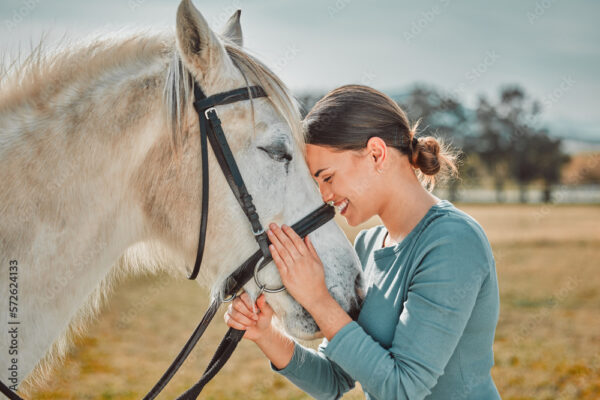
Finding the perfect saddle doesn't have to be complicated.
At DK Saddlery, we're committed to helping riders understand proper saddle fitting, from identifying correct sweat patterns and tree point angles to choosing between air-filled and wool-stuffed saddles.
Whether you're wondering how to order a custom DK Saddle, how to assess if your current saddle is moving forward onto your horse's shoulders, or what type of girth promotes optimal movement and breathing, you'll find answers here. Our saddles are designed with both horse and rider comfort in mind, promoting freedom of movement, better blood flow, and improved muscle development.
Browse the questions below to learn more about saddle fitting principles, ordering options, and how to connect with a DK Saddlery representative or attend a fitting clinic with Danny Kroetch in your area.
Frequently Asked Questions
How do I order a DK Saddle? + −
There are three options for ordering a DK Saddle:
- Use the order form, send photos, and place your order directly.
- Visit the Reps page on the website to locate a representative in your area and arrange a personal fitting session.
- Attend a fitting clinic with Danny Kroetch. Check the Schedule page to find upcoming clinics in your area.
What should the sweat mark patterns on my horse's back look like after a ride? + −
A correct sweat pattern should show equal panel contact on both sides. However, due to the girthing system and the stirrup bar location, 70% of the weight-bearing surface of the saddle tree presses on the front part of the horse's back. Therefore:
- The front half of the panel should stay clean and dry because constant contact with the horse's back prevents airflow, which is needed for sweat to form.
- The back half of the panel should be wet and dirty, as sweat is created when air and heat mix in this area.
How can I tell if the tree in my saddle is fitting my horse correctly? + −
To check the tree point angle:
- Place the saddle on the horse's back without a pad.
- Press straight down on the pommel with one hand on top of the other.
- If the back of the saddle lifts off the horse's back, the tree points are not fitting the withers correctly.
- Look for small dry spots on the top part of the withers on both sides.
- If present, the top of the tree point is too tight.
What should I do if my saddle moves forward onto my horse's shoulders? + −
- This issue often occurs when the tree is too tight at the top, and the bottom of the tree point does not make contact with the horse.
- As the horse lifts its back, the saddle is pushed forward over the shoulders.
If my saddle is not fitting, what type of pad should I use to fix the problem? + −
Using a pad to fix a poorly fitted saddle is not recommended. Pads often exacerbate the problem rather than correcting it. For example, adding padding to a tight shoe only makes it tighter. The solution to an ill-fitted saddle is always to adjust the saddle itself, not to rely on padding.
What is the difference between an air-filled saddle and a wool-stuffed saddle? + −
Every horse deserves the comfort of an air-filled saddle due to its horse- and rider-friendly design:
- Air-filled saddles adapt to the horse's movements and reduce resistance. This ensures the saddle fits the horse 100% of the time during motion.
- ;Wool-stuffed saddles are more rigid and can create resistance as the horse moves, interacting with the muscles and bones less effectively.
- Properly fitted air-filled saddles promote freedom of movement, better blood flow in the muscles, faster healing, and improved muscle development.
Concerns about air-filled saddles "bouncing" are unfounded if the saddle is properly fitted. An air-filled saddle, when fitted correctly, performs just as well as any other saddle, with the added benefit of increased comfort for the horse.
How does the girth affect how a horse moves? + −
A properly fitted girth is essential for horse comfort and movement:
- Elasticity: The girth should have elastic on both ends to accommodate the horse's breathing, which increases 12–16 times during motion. A rigid girth can restrict breathing and result in erratic breathing patterns.
- Length: The girth should not interfere with the horse's elbows. For a dressage girth, subtract 48–50 inches from the horse's girth circumference. For a jumping girth, subtract 25 inches.
- Width: A girth with a wide, weight-bearing surface (at least 4 inches in the center) is recommended. For horses that are downhill or barrel-shaped, a 7-inch diamond-shaped girth can help align the saddle billets perpendicularly.
How do I become a DK Saddlery clinic organizer in my area? + −
To become a clinic organizer, contact the DK Saddlery team through the toll-free number 1-877-DAN-FITS or via our contact page. Further details and benefits of being a clinic organizer will be provided upon inquiry.